


Running a modern company in the United States means you are always looking for better efficiency. You likely want to streamline operations while keeping your quality extremely high. Choosing the right technology is a big part of that journey.
Your goal is to find a balance between speed and accuracy. You want to cut down on errors from manual data entry. Smart systems can give your team the relief they need and help them grow.
Many leaders now look at business automation to handle their heavy lifting. Every software provider claims to offer the perfect solution for your specific business needs. But not all digital tools work the same way in real life.
It is important to see how AI automation differs from traditional setups. One follows strict “if-then” logic while the other processes data more like a human person. Knowing these differences helps you invest your budget wisely for long-term success.
Key Takeaways
- Rule-based tools need manual updates for every new task.
- Smart systems learn from data to handle complex workflows.
- Scaling is much easier with flexible and adaptive digital solutions.
- Efficiency increases when you remove repetitive manual chores.
- Modern software adapts to changes without needing constant code edits.
What Automation Means for Your Business Today
As a business owner, you might see many automation options. Each has its own benefits and uses. Automation is not just about replacing people; it’s about making things better and more efficient.
The world of business automation is wide and changing. New technologies are coming out to help with different needs.
The Evolution of Automation Technology
The history of automation technology is amazing. It started with simple machines and now includes AI. At first, it was just for simple tasks. But now, it can handle complex decisions.
Now, business automation has many tools and technologies. They help make things run smoother, improve customer service, and bring new ideas. Knowing how automation has changed is important for using it well.
Why Understanding Your Options Matters Now
There are many automation options out there. It’s important to know what each can do for your business. The right choice depends on your needs, like how complex the tasks are and how much you need to grow.
By looking at your automation options, you can make smart choices. This ensures your business goals are met and you get the most out of automation without problems.
Understanding Traditional Automation and How It Works
To understand automation, knowing how traditional automation works is key. It has been a big help in business for years. Its rule-based way is still very useful for many companies.
Core Principles of Rule-Based Automation
Rule-based automation uses set rules to do tasks. It’s great for things that happen over and over. These rules are like if-then statements, helping businesses make decisions automatically.
For example, a company might use it to assign tasks based on who is doing them. Or to send out notices when certain things happen.
Automation expert says,
“Rule-based automation is about defining the rules that govern your business processes and using technology to enforce them consistently.”
This way, tasks are done right and the same way every time. It helps avoid mistakes made by people.
How Traditional Systems Process Your Tasks
Traditional automation systems follow the rules and paths set up in them. They map out business processes and find tasks to automate. Then, they set up the software to do these tasks.
The steps are:
- Find tasks that are the same and can be automated
- Set up the rules and paths for these tasks
- Set up the automation software
- Test and make the automated processes better
Common Tools and Technologies Available to You
There are many tools and technologies for traditional automation. They range from simple software to complex systems. Some well-known ones are:
| Tool/Technology | Description | Key Features |
|---|---|---|
| Zapier | Workflow automation tool | Works with many apps, makes workflows automatic |
| Microsoft Power Automate | Business process automation | Works with Microsoft products, has advanced workflow features |
| Automation Anywhere | Robotic Process Automation (RPA) | Makes repetitive tasks automatic, works with different systems |
These tools help businesses automate many tasks. This makes things more efficient and cuts down on mistakes.
Understanding AI Automation and Its Capabilities
AI automation can really help your business be more flexible and quick to respond. It’s important to know how it’s different from old ways of automating things.
What Sets AI Automation Apart
AI automation is special because it can look at lots of data, learn from it, and make smart choices. It’s not like old automation, which just follows rules. AI uses machine learning algorithms to get better with new info and changes.
This flexibility is great for tasks that are not always the same. For example, in customer service, AI chatbots can deal with many kinds of questions. They don’t need to be told how to handle every question.
How Machine Learning Adapts to Your Needs
Machine learning is a part of AI that lets systems get better over time. They learn from data and get smarter. This way, they can predict what will happen next and suggest things based on what they’ve learned.
This means AI automation can get better and more accurate as it gets more data. This is really helpful in places where things are always changing, like in money forecasting or managing supplies.
Key Technologies You Should Know About
There are a few main technologies that make AI automation work. These include:
- Natural Language Processing (NLP): Helps computers understand and make human language, like in chatbots and voice helpers.
- Predictive Analytics: Uses past data to guess what will happen next, helping businesses make smart choices.
- Computer Vision: Lets machines see and understand pictures and videos, useful for checking quality and watching over things.
Knowing about these technologies can help you find ways to use AI automation in your business. It can lead to new ideas and growth.
AI Automation vs Traditional Automation: The Key Differences
Understanding the difference between AI and traditional automation is key. It’s not just about the tech. It’s about how each can change your business.
Flexibility and Adaptability in Your Workflows
Traditional automation is set in stone. It doesn’t change with new data or needs. AI automation, however, can adjust to new info and business changes.
Key differences in flexibility include:
- Ability to handle exceptions and unexpected data
- Capacity to learn from experience and improve over time
- Flexibility in processing varied data formats and sources
Decision-Making Capabilities You Can Expect
AI automation makes decisions with advanced algorithms. It can analyze complex data and make smart choices. Traditional automation follows set rules.
The decision-making process in AI automation involves:
- Data analysis and pattern recognition
- Predictive modeling based on historical data
- Continuous learning and improvement
Learning and Continuous Improvement Features
AI automation learns and gets better over time. It uses machine learning to adapt to new data and situations.
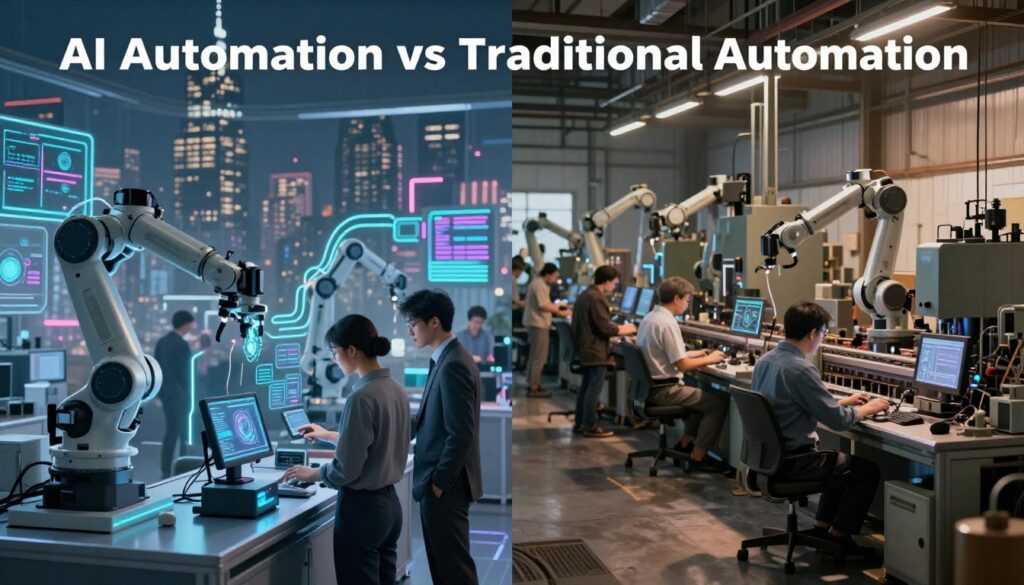
How Each Handles Complex Scenarios
AI and traditional automation handle complex situations differently. AI can deal with complex, changing scenarios by analyzing many variables and adjusting its response.
| Capability | AI Automation | Traditional Automation |
|---|---|---|
| Handling Complex Data | Advanced analysis and adaptation | Limited to predefined rules |
| Decision Making | Informed by data analysis and machine learning | Based on pre-programmed instructions |
| Flexibility | Highly adaptable to new scenarios | Rigid and less adaptable |
Comparing the Benefits and Limitations of Each Approach
When picking automation for your business, knowing the good and bad of traditional and AI automation is key. Both have their ups and downs. It’s important to compare them well.
What Traditional Automation Delivers for Your Operations
Traditional automation is great for tasks that repeat and follow rules. It makes things reliable and efficient for tasks that are clear and don’t need hard decisions. It lets your team do more important work.
Some main benefits of traditional automation are:
- Predictable outcomes: It follows set rules for steady results.
- Lower implementation costs: It starts with a smaller investment than AI.
- Ease of implementation: It’s simpler to set up and use.
Advantages AI Automation Brings to Your Business
AI automation adds a new level of smartness to your work. It’s good at handling complex tasks that need adaptability and learning. It looks at lots of data, finds patterns, and makes smart choices.
The benefits of AI automation are:
- Enhanced decision-making: It makes smart choices quickly.
- Flexibility and adaptability: It changes with new situations and gets better over time.
- Handling complex tasks: It’s great at tasks with lots of data or need careful thinking.
Cost and Resource Considerations for Your Budget
Cost matters a lot when choosing automation. Traditional automation costs less upfront but might not grow or change as much. AI automation costs more to start but can save more money and grow over time.
Think about the costs and what you need to keep things running for each type. This includes:
| Automation Type | Initial Cost | Ongoing Resources |
|---|---|---|
| Traditional Automation | Lower | Maintenance and updates |
| AI Automation | Higher | Data management, training, and updates |
By looking at these points, you can pick the best automation for your business and budget.
How to Assess Your Business Automation Needs
Figuring out your business automation needs is key to picking the right solution. You need to look at several important factors. These will help you decide between AI and traditional automation.
First, understand what your business needs. Look at your current processes, how you handle data, and your growth plans. This will help you choose the right automation.
Step 1: Evaluate Your Current Process Complexity
Start by checking how complex your business processes are. Think about the steps, decisions, and how tasks are done. If your processes are complex or need smart decisions, AI might be better.
- Find tasks that take up a lot of time and resources.
- Look at the decisions made in your workflows.
- See how much human judgment is needed in your operations.
Step 2: Analyze Your Data Volume and Variability
The data your business handles is very important. AI is great for big, varied data sets. It can learn from this data to make processes better.
Think about your data sources, formats, and how it’s processed now. This will help you decide if you need a solution for complex data.
Step 3: Determine Your Scalability Requirements
Scalability requirements are crucial when picking an automation solution. Think about your business’s growth and how processes might change. AI is usually more flexible and scalable, adapting to new data and processes easily.
Look at your current setup and how it supports or limits growth. Consider integration, data handling, and adapting to new needs.
Step 4: Review Your Available Budget and Resources
Lastly, check your budget and resources. Automation needs money and people for setup, training, and upkeep. Traditional automation might be cheaper for simple tasks, but AI offers more benefits over time.
Think about software, hardware, training, and consulting costs. Also, consider your team’s skills and if you need to hire more staff or consultants.
By carefully looking at these factors, you can choose the right business automation needs for your organization.
How to Choose the Right Automation Type for Your Goals
Choosing the right automation for your business needs is key. You must understand your workflows and goals well. It’s important to make choices that fit your business.
To make the right choice, follow a few steps. This will help you find the best automation for your company.
Step 1: Map and Document Your Existing Workflows
Start by mapping and documenting your workflows. This helps you see how tasks are done now. It also shows where automation can help the most. Use flowcharts or diagrams to see your processes and find where they can be better.
Step 2: Match Tasks to the Appropriate Automation Type
After understanding your workflows, match tasks to the right automation. Think about if tasks are repetitive, follow rules, or need complex decisions. Traditional automation works well for tasks that follow rules. AI automation is better for tasks that need data analysis and making decisions.
Step 3: Calculate Your Expected Return on Investment
It’s important to figure out your expected return on investment (ROI). Think about how automation can save money, make things more efficient, and improve accuracy. Use data and past trends to guess how much ROI your project will have.
Step 4: Assess Your Team’s Technical Readiness
Lastly, check if your team is ready to use the chosen automation. Think about the skills and training needed for the new tech. Make sure your team can handle the tools and solve problems.
By following these steps, you can choose the best automation for your business goals. This will help your organization succeed.
How to Implement Your Automation Solution Successfully
Automation can change your business for the better. But, it needs a good plan to work. You must think about several important things to make your automation project a success.
Creating Your Automation Roadmap
First, make a detailed automation roadmap. This means setting your business goals, checking your current processes, and picking what to automate. Your roadmap should show what to do, when, and how much it will cost.
Key elements to include in your automation roadmap:
- Clear objectives and expected outcomes
- Process assessment and identification of automation opportunities
- Resource allocation and budgeting
- Timeline and milestones
Selecting the Right Platforms and Vendors
Picking the right automation tools and vendors is key. Look at different options based on what your business needs. Think about how well they fit with what you already have.
Consider the following factors when selecting a vendor:
- Experience and expertise in automation
- Customer support and service level agreements
- Integration capabilities with your existing infrastructure
- Scalability and flexibility of the solution

Preparing and Training Your Team
Getting your team ready for automation is crucial. You need to teach them about new processes and tools. Also, be ready to handle any worries or resistance to change.
Effective training strategies include:
- Hands-on training sessions
- Documentation and user guides
- Ongoing support and feedback mechanisms
Setting Up Performance Metrics and KPIs
To see if your automation is working, you need to set up clear goals and KPIs. These should match your business goals and show how well your automation is doing.
Examples of relevant metrics include:
- Process efficiency improvements
- Cost savings
- Error reduction
- Customer satisfaction
Overcoming Common Automation Challenges You’ll Encounter
When you start using automation in your business, you’ll face some challenges. These can affect how well your automation works. You need a good plan and careful steps to get past these problems.
Solving Integration Issues with Legacy Systems
One big automation challenge is linking new systems with old ones. This can be hard if your old systems are outdated or not compatible with new tech.
To solve this, check your current setup and find where you can connect new systems. Use APIs, middleware, or other tools to help your new systems talk to the old ones.
Addressing Data Quality and Availability Concerns
Good data quality and availability are key for your automation to work well. Bad data can give wrong results, and missing data can stop processes.
To fix these issues, make sure your data is clean and reliable. Also, have a plan to back up and recover your data when needed.
Managing Change Resistance in Your Organization
Automation brings big changes to your team, and managing these changes is vital. Talk to your team about the benefits of automation and involve them in the process. This can help them accept the changes better.
Offer training and support to help your team adjust. Teach them about new tools and processes. Also, be ready to help with any concerns or problems they might have.
Planning for Ongoing Maintenance and Updates
Automation needs regular care and updates to keep working well. Create a plan for maintenance that includes updates, fixing problems, and checking how things are going.
Keep watching your automation and make changes when needed. This helps catch and fix issues before they get big.
Real-World Applications You Can Implement Today
Looking at real-world examples of automation shows how technology changes industries. It makes businesses work better and serve customers more.
Streamlining Manufacturing and Production Processes
In manufacturing, automation makes production faster and cheaper. Manufacturing automation uses robots and machines for tasks humans used to do. This makes products better and more consistent.
Car makers use automated lines to make cars quicker. The electronics world uses automation for precise tasks like putting parts together and checking quality.
Enhancing Customer Service and Support Operations
Customer service automation helps businesses a lot. Chatbots and virtual assistants answer questions and help with transactions. This lets human helpers deal with harder issues.
Automation also makes customer interactions more personal. By using customer data, businesses can offer what each person wants. This makes customers happier.
Optimizing Financial Services and Transaction Processing
In finance, automation makes transactions faster and more accurate. It also helps follow rules better. Automated systems handle lots of transactions, letting staff do more important work.
Banks use automation for payments, account management, and catching fraud. This makes them more efficient and secure, building trust with customers.
Improving Healthcare Operations and Data Management
The healthcare world benefits from automation, especially in managing data and making things run smoother. Automated systems handle patient records, appointments, and insurance claims.
Automation is also key in medical research and diagnosis. It helps doctors analyze data and focus on patient care and new treatments.
Building a Hybrid Automation Strategy for Maximum Impact
A hybrid automation strategy combines traditional and AI-driven automation. This mix creates a solution that meets your business needs and boosts efficiency.
When to Combine Both Automation Approaches
Use a hybrid strategy when your business needs both traditional and AI automation. For example, traditional automation is good for routine tasks. AI is better for complex, data-driven tasks.
Key scenarios for hybrid automation include:
- Handling high-volume, repetitive tasks with traditional automation
- Using AI automation for tasks that require adaptability and machine learning
- Integrating both approaches to manage complex workflows
Creating Your Phased Implementation Timeline
To implement a hybrid strategy, create a phased timeline. First, assess your current processes. Then, find areas where automation can make a big difference.
Steps to create your timeline:
- Assess your current processes and identify automation opportunities
- Prioritize tasks based on complexity and business value
- Develop a rollout plan that integrates both traditional and AI automation
- Monitor progress and adjust your strategy as needed
Future-Proofing Your Automation Investment
To make your automation investment last, choose scalable and adaptable solutions. Look for platforms that support both traditional and AI automation. Also, invest in technologies that grow with your business.
Consider the following:
- Scalability of your automation solutions
- Flexibility in integrating new technologies
- Ongoing support and maintenance requirements
Conclusion
As you finish this guide on AI automation vs traditional automation, you know more about choosing the right one for your business. It’s important to understand the differences between these technologies. This helps you pick the best one for your company’s needs.
Start your automation journey by looking at what your business needs. Then, see the good and bad of each technology. This way, you can choose AI, traditional, or a mix that fits your goals.
The main point is clear: the right automation can change your business for the better. It makes things more efficient and helps your business grow. When deciding between AI and traditional automation, think about things like flexibility and how well they can make decisions. This ensures you get the most out of your investment.
FAQ
What is the primary technical difference between traditional automation and AI-driven solutions for your business?
Traditional automation, or RPA, uses simple rules. It’s good for tasks that follow a set pattern. AI, on the other hand, uses learning to handle new data. This lets systems make decisions on their own.
How can AI automation improve your customer service operations specifically?
AI can understand what customers mean, not just what they say. Tools like Salesforce Einstein can help. This way, your business can solve problems better and talk to customers in a more personal way.
Why is it important to assess your data volume and variability before choosing a platform like Microsoft Power Automate?
The right tool depends on your data. If your data is simple and consistent, traditional tools work well. But if your data is complex, AI is needed to understand it first.
Can you integrate modern AI automation with your existing legacy systems?
Yes, but it takes planning. You can use special connectors to link AI with older systems. This way, you can use new data without changing everything.
What are the key factors you should use to calculate the ROI of your automation roadmap?
Look at more than just saving money. Consider how fast and accurate your processes are. For example, AI from AWS might cost more upfront but can grow with your business.
When should you consider building a hybrid automation strategy instead of choosing just one approach?
Go for a hybrid strategy if you have simple and complex tasks. Use RPA for the easy stuff and AI for the hard parts. This way, you can grow without replacing everything at once.
How do you manage change resistance among your team when introducing AI technologies?
Show your team how AI helps, not replaces them. Use tools like OpenAI’s GPT to make their jobs easier. Set goals that reward teamwork with AI for a smooth transition.